Insight · USDA Section 9003
Section 9003 Isn’t Broken. The Map Is.
Why the program rural America wrote off may be the most relevant tool we have — and how developers should actually use it.
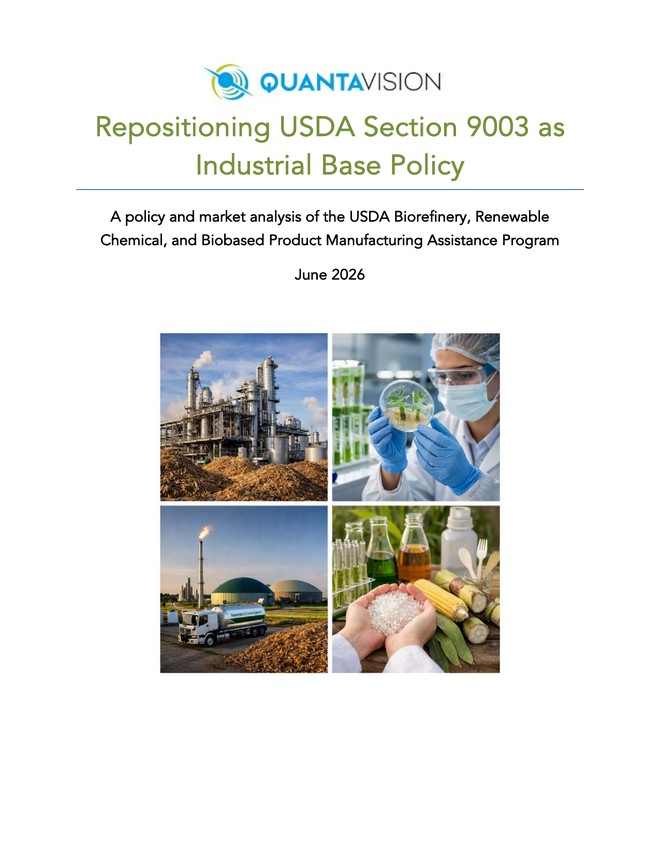 Read the White Paper →
Insight · USDA Section 9003
Why the program rural America wrote off may be the most relevant tool we have — and how developers should actually use it.
Read the White Paper →
For eighteen years, I’ve watched people write off the USDA 9003 program for failures that were never the program’s fault.
A developer does everything right. Real technology. Real team. Feedstock locked. The project still doesn’t get built — and when it stalls, the verdict comes fast: Section 9003 doesn’t work. Too slow. Don’t bother. I was there for a lot of those stories. That is almost never what happened.
I’ve worked inside the USDA Section 9003 program since it was written into the 2008 Farm Bill — application after application, alongside a small group of people who have actually walked the full trail to financial close. Most of what stalls a 9003 project has nothing to do with 9003.
So let me set something straight, because the timing matters.
The misconception worth correcting isn’t “it’s only for fuels,” or “it’s too slow.” It’s the quiet belief underneath: that 9003 isn’t relevant to what we’re building now. It is. It may be the most relevant deployment tool we have for a domestic bioeconomy — turning rural feedstocks and waste into materials, chemicals, fertilizer, and fuel, built here instead of bought from abroad.
Here’s why this matters more now than it did even a few years ago. The producers I work with are squeezed — thin margins, and capital that costs more to borrow than it used to. Rural communities are competing hard for the kind of industrial investment that brings skilled jobs and a stable tax base. And the country keeps colliding with the same two problems: supply chains that snap under pressure, and breakthrough technologies we invent here only to watch them get built at scale somewhere else. Biomanufacturing and waste-to-value projects sit right where all of that meets — they take the feedstocks and waste streams scattered across rural America and turn them into high-value industrial products.
Positioned the right way, 9003 isn’t a niche grant program — it’s an industrial scale-up tool. It strengthens rural economies and builds the domestic capacity to make the fertilizers, chemicals, materials, and fuels we’d otherwise import. And I’ve seen what that framing does for bankability. The projects that get financed aren’t the ones with the prettiest green label; they’re the ones with durable offtake — products that win on performance, reliability, quality, or supply security. When something is genuinely better or more dependable, demand holds up across cycles, and that’s a deal a lender can actually underwrite.
I’ve spent eighteen years on this trail. The program isn’t broken. It’s standing right where we left it, ready to work — if Congress funds it, if USDA runs it like the strategic tool it is, and if developers walk in with a map instead of a hope.
If you’re a developer, here’s the part the white paper won’t tell you.
Map the whole path to close before you submit Part One — not the application, the close. Too many developers get accepted and only then ask where the money comes from. The development work to move through the program can run into the millions, and that development capital is the riskiest, hardest money in the stack. Being “in the program” does not make investors appear. Plan for that capital on day one.
Before any of it, the gate: secured feedstock, a creditworthy offtake, an EPC who will stand behind a number, and enough R&D behind you that the demonstration stage is a step, not a leap.
And for this market, the one I’d underline: stop asking how big you can build it. Ask how small. The billion-dollar facilities aren’t moving. Small, profitable units that cash-flow on their own and then replicate — those are getting built. Prove one. Build the next one cheaper.
Here’s why I’m writing this today and not next year. The House is fast-tracking a Farm Bill. The Senate’s is in markup. I’ve been through enough of these to know how it ends if we stay quiet — down to the wire, never enough money, and the programs without a champion get trimmed.
And there’s a question almost no one is asking. Congress was told to put fifteen billion dollars into rebuilding America’s biotech industrial base. Good. But funding discovery with no rails to commercialize it is a bucket with no bottom. 9003 is one of the few deployment programs we already have. You can’t fund the science, starve the scale-up, and call it a strategy.
That’s what industrial base policy actually means. Invent it here, build it somewhere else, and we lose the supply chain, the jobs, the know-how, and the standing. The projects 9003 finances — biodegradable materials from corn, fertilizer made from air and water at the edge of a field, aviation fuel from dairy waste — are exactly the small, distributed, rural manufacturing that keeps value in the country.
The mountain hasn’t moved. We just have to climb it on purpose.
The Full Case
The complete analysis — the market data, the policy argument, and the specific reforms Section 9003 needs in the 2026 Farm Bill to function as the deployment engine for America’s biotech industrial base.
Before you submit Part One, benchmark yourself against the nine constraints that decide whether a first commercial project gets financed and built. A free 27-question self-assessment — about fifteen minutes.

Founder and CEO of QuantaVision, a firm that since 1994 has helped innovators in renewable fuels, renewable chemicals, biobased products, and value-added agriculture finance and build their projects. She has worked inside the USDA Section 9003 program since its creation in the 2008 Farm Bill and is one of its most active practitioners, guiding developers through the full path from concept to financial close. She writes and speaks regularly on financing the bioeconomy. Connect on LinkedIn or at quantavision.earth.